What you need
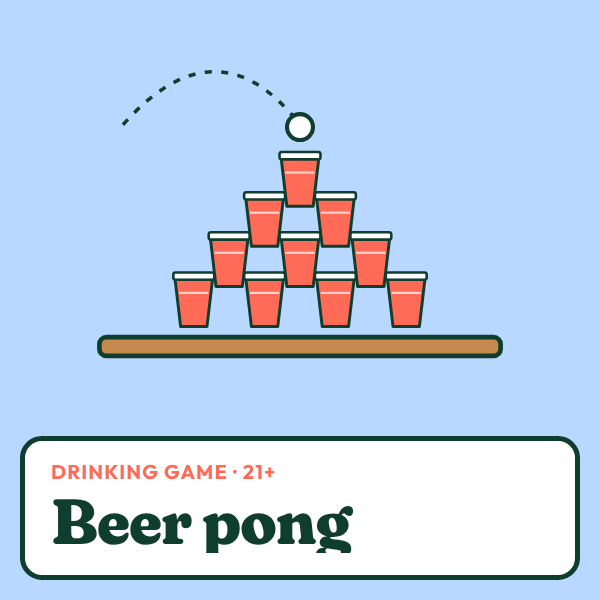
At least ten plastic cups (add ten more for every five extra players), two ping pong balls and a table everyone can stand around. Three players minimum. It uses the same kit as beer pong, so it is often played on the same table.
Rage Cage is an adult drinking game, and a fast one: you can be handed a new cup several times a minute. Play it only with people of legal drinking age (21 in the United States), never pressure anyone to drink, keep each cup to a small sip, have water on the table between games, and never drive afterwards. The game works perfectly with water or soft drinks in the cups, or with empty cups and a point each time you get stacked.
Setup
Put the cups in a tight ring in the middle of the table. The sources fill each cup about a third full and one centre cup to the top; for a responsible game, pour only a sip in every cup, the centre one included.
Everyone stands round the table. Choose a first player (the youngest, for example); the player directly opposite also starts. Give each of them a ball.
How to play
- On “3, 2, 1”, the two starting players each take the nearest cup from the ring, drink it, and start bouncing their ball off the table, aiming for that now-empty cup.
- When your ball lands in your cup, pass the cup and ball to the player on your left (clockwise). They start bouncing straight away.
- If you make it on your first bounce, you may pass the cup to any player, not just your neighbour.
Stacking
The two cups chase each other round the table. If you sink your ball while the player on your left is still trying, you stack your cup into theirs. They have been caught:
- they pass the stacked cups to their left, along with a ball,
- they take a new cup from the middle, drink it, and start bouncing into that cup with the other ball.
The stack grows taller as the game goes on, which makes it harder to hit.
Landing in a middle cup
If your ball lands in one of the cups in the middle, take that cup, drink it, stack it on your own and keep bouncing.
Scoring and winning
The game ends when the middle cups are gone. There is no winner by default; if someone keeps score, the player who stacked others most often wins. In the alcohol-free version, count how many times each player is caught and the lowest score wins.
Common variants
- Slap Cup. Often confused with Rage Cage. Instead of stacking your cup onto a slower player’s, you slap their cup off the table, and they take a new one from the middle.
- Scorekeeper. One player keeps a tally of stacks, handy if Rage Cage is one event in a beer olympics.
- Alcohol-free. Empty cups, points for each time you are caught. The bouncing race is unchanged.
Tips for first games
- Keep the pours tiny. Players who are slow at bouncing can be caught again and again in a short time, so a full cup each time is far too much.
- Bounce softly, close to your cup. A low, gentle bounce goes in more often than a hard one.
- If you sink on the first bounce, pass to the player just left of whoever is still bouncing, so they are caught quickly.
Frequently asked questions
Are Rage Cage and Slap Cup the same game? No. They share the set-up, but in Rage Cage you stack your cup onto your neighbour’s, while in Slap Cup you knock their cup away.
Can you play Rage Cage with two people? No. You need at least three players so that one cup can catch up with another.
How many cups do you need? At least ten in the middle for five players, plus ten more for every five extra players.
When does the game end? When every cup in the middle has been taken.